

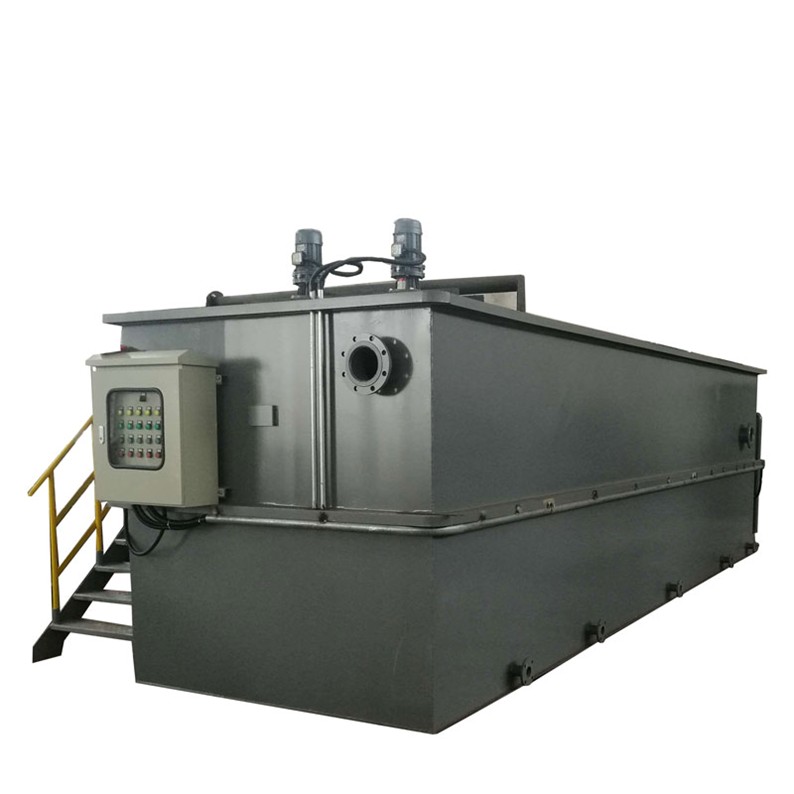
A DAF wastewater treatment package, or dissolved air flotation system, is one of the effective physical–chemical methods for separating fat, oil, grease, light suspended solids, and colloidal particles from industrial wastewater.
In this method, very fine air bubbles attach to the pollutant particles and cause the particles to move to the surface of the tank. The floating material created at the surface is collected by a skimmer and separated from the wastewater flow.
The DAF package is usually used in industries whose wastewater contains fat, oil, suspended solids, colloidal materials, or a pollution load caused by floating materials. This system can be used as pre-treatment before biological units such as SBR, MBBR, MBR, or A2O and reduce the pollution load entering the subsequent stages.
By reviewing the wastewater analysis, the flow rate, the amount of fat and oil, the TSS, the COD, the pH, the available space, and the required output effluent standard, Poly Payesh designs and builds the DAF wastewater treatment package to suit the conditions of each project.
What Is the DAF System?
DAF stands for Dissolved Air Flotation. This process is used to separate pollutants whose specific gravity is close to that of water, that do not settle easily, or that exist in the wastewater in the form of fat, oil, grease, and light particles.
In the DAF system, part of the treated water or the return flow is saturated with air under pressure. Then this flow enters the flotation tank at a lower pressure, and the air is released in the form of microbubbles. The microbubbles attach to the particles and the formed flocs and guide them to the surface of the water.
At the surface of the tank, a layer of floating material — including fat, oil, grease, floc, and sludge — is created. This layer is removed by a skimmer or a surface collection system and transferred to the sludge section for dewatering, disposal, or further management.
What Pollutants Is the DAF Wastewater Treatment Package Suitable For?
The DAF system can be considered for reducing or separating the following pollutants:
- Fat, oil, and grease (FOG)
- Suspended solids (TSS)
- Light and floating particles
- Colloidal particles
- Part of the organic matter attached to fat and suspended solids
- Color and turbidity caused by suspended particles, in some wastewaters
- Flocs formed after coagulation and flocculation
- Part of the COD and BOD pollution load that is dependent on suspended or oily materials
DAF alone is usually not sufficient for removing dissolved pollutants. If a significant part of the COD, BOD, salts, chemicals, or pollutants exists in the wastewater in dissolved form, biological, chemical, membrane, or supplementary treatment units may be needed.
How the DAF Wastewater Treatment Package Works
The operation of the DAF unit usually consists of several main stages. The order and type of equipment in each stage must be determined based on the wastewater analysis and the project needs.
1. Screening and Initial Pre-treatment
Before entering the DAF package, industrial wastewater may pass through a screen, a grit chamber, a primary grease trap, or an equalization tank. This stage prevents the entry of coarse particles, fibers, plastic, large solids, and pollutants that can cause clogging of the pumps or equipment.
In many projects, an equalization tank is also essential for reducing flow fluctuation, evening out the pollution load, and better controlling the process.
2. pH Adjustment and Chemical Dosing
In many industrial wastewaters, the pH of the wastewater must be adjusted before entering the DAF unit. Then, according to the results of the wastewater analysis and the jar test, suitable chemicals are dosed.
The materials used may include the following:
- Coagulant
- Coagulant aid
- Polymer (flocculant)
- pH-adjusting materials
- Antifoam or auxiliary materials required by the project
Coagulants reduce the electric charge of the fine particles, and polymers help form larger flocs that can be floated. The type and amount of chemicals must be chosen by testing and a real review of the wastewater, because using more or less than needed can reduce the DAF efficiency.
3. Saturating the Water with Air
In this stage, part of the output water or the return flow is fed into the saturation tank by a special pump. Air is mixed with the water under pressure and dissolved in it.
The goal of this stage is to create water rich in dissolved air to produce microbubbles in the flotation section.
4. Releasing the Microbubbles
After passing through a special valve or nozzle, the air-saturated water enters the DAF tank. With the sudden reduction of pressure, the dissolved air is released in the form of very fine bubbles.
These microbubbles attach to the flocs, suspended particles, fat, and oil. As a result, the specific gravity of the particle-and-bubble combination decreases, and the particles move toward the surface of the water.
5. Flotation and Formation of the Sludge Layer
The floating material gathers at the surface of the tank and forms a layer of sludge, fat, oil, and floc. This layer, sometimes known as the float or scum, must be collected from the surface of the tank continuously or periodically.
6. Collecting the Floating Sludge
A skimmer, paddle, collection chain, or similar mechanical equipment guides the floating layer at the surface of the tank toward the sludge pit or tank.
The collected sludge may be managed for dewatering, thickening, transfer to a filter press, drying, or final disposal. The design of the sludge section is very important in industrial projects, because the volume and composition of the DAF sludge depend on the type of wastewater and the chemicals used.
7. Transferring the Effluent to the Next Treatment Stage
Depending on the type of wastewater and the required standard, the output effluent from DAF can enter one of the following stages:
- SBR wastewater treatment package
- MBBR wastewater treatment package
- MBR wastewater treatment package
- A2O process
- Supplementary chemical treatment unit
- Sand filter, carbon filter, or filtration system
- Disinfection system
- Membrane units such as UF or RO, if needed
Main Components of the DAF Wastewater Treatment Package
The equipment of the DAF package is determined according to the capacity, the type of industry, the wastewater quality, and the level of automation required. A DAF system can include the following components:
- Screen (trash rack) or pre-treatment equipment
- Equalization tank
- pH-adjustment tank
- Coagulation tank
- Flocculation tank
- Coagulant dosing system
- Polymer dosing system
- Wastewater transfer pump
- Air saturation tank
- Pressure pump or circulation pump
- Compressor or blower for the required air
- Pressure control valves and release nozzles
- Main DAF tank
- Skimmer or floating sludge collection system
- Sludge tank
- Electrical panel and control system
- Flow meter, pressure gauge, pH meter, and the required monitoring equipment
- Automation system and PLC, if the project requires it
Advantages of the DAF Wastewater Treatment Package
If the DAF process is designed and operated to suit the type of wastewater, it can have significant advantages:
- Effective separation of fat, oil, and grease from industrial wastewater
- Reducing suspended solids and colloidal particles
- Reducing part of the COD and BOD dependent on particles and fat
- Reducing the pollution load entering the biological systems
- Helping prevent clogging, foam formation, and disruption in the subsequent units
- Suitable for wastewaters containing fat or floating materials
- The possibility of continuous operation
- The ability to be equipped with a control and automation system
- The ability to be designed in capacities proportional to the project flow rate
- Helping improve the operating conditions of the industrial treatment plant
Limitations of the DAF System
DAF is not the best solution on its own for all types of wastewater. Before choosing this system, its limitations must also be considered:
- It is not sufficient on its own for removing dissolved pollutants.
- The system’s performance depends on the quality of the inlet wastewater.
- The type and amount of chemicals must be chosen based on the jar test.
- Severe changes in pH, flow rate, or pollution load can affect the efficiency.
- The floating sludge produced must be managed and disposed of correctly.
- Some wastewaters need an equalization tank, a primary grease trap, or supplementary units.
- The pressurized equipment, pumps, nozzles, and chemical dosing system require periodic servicing and maintenance.
The Difference Between DAF and Gravity Settling
In the gravity settling system, particles heavier than water go to the bottom of the tank and are collected from the lower part. This method is suitable for heavy, settleable particles.
But in many industrial wastewaters, the pollutants exist in the form of fat, oil, grease, light particles, or colloidal materials and do not settle easily. In such conditions, DAF moves the particles to the surface with the help of microbubbles and makes it possible to collect them.
Therefore, DAF is not a complete replacement for all settling tanks; rather, in wastewaters that contain light, oily, greasy, or colloidal materials, it can be a more suitable option than simple settling.
What Is the Difference Between DAF and a Grease Trap?
A grease trap is usually a simpler unit for the initial separation of free oil and fat based on the difference in specific gravity. This unit is used more for removing free and coarse fats.
But DAF is a more advanced process that, using microbubbles, coagulation, and flocculation, can also largely separate dispersed and emulsified fats, suspended particles, and formed flocs.
In some projects, using a grease trap before DAF can help reduce the initial load and improve the performance of the whole system.
Applications of the DAF Wastewater Treatment Package
The DAF package can be used in various industries, but the final choice must be made after reviewing the wastewater analysis. Some of the common applications are:
- Dairy industries
- Edible oil production industries
- Meat processing plants
- Slaughterhouses
- Poultry and protein industries
- Beverage production plants
- Food and canning industries
- Industrial kitchens and large restaurants
- Oil, gas, and petrochemical industries
- Refineries
- Textile industries
- Paint and printing industries
- Paper and cellulose industries
- Cosmetic and sanitary industries
- Chemical industries
- Recycling and industrial washing units
- Projects that need to reduce fat and TSS before biological treatment
The Position of DAF in a Complete Industrial Wastewater Treatment Line
In many industrial projects, DAF is only one of the units of the treatment line. The final layout depends on the type of wastewater and the output standard, but a common arrangement can be as follows:
- Screening and separation of coarse particles
- Equalization tank
- pH adjustment
- Coagulation and flocculation
- DAF package for removing fat, oil, and suspended solids
- Biological treatment such as SBR, MBBR, MBR, or A2O
- Settling or sludge separation
- Supplementary treatment if needed
- Disinfection and effluent storage
In some industries, other pre-treatment or supplementary treatment stages may also be needed. Choosing the suitable arrangement must be based on the effluent analysis and the discharge or reuse standard.
What Wastewaters Is the DAF Package Not Suitable For?
DAF alone is usually not sufficient for wastewaters whose major part of pollution is in the form of dissolved materials. For example, a wastewater with high dissolved COD, high salinity, heavy metals, toxic substances, or special chemical compounds may also need other processes.
Also, in wastewaters with severe fluctuation in flow rate or pollution, implementing an equalization tank and properly controlling the chemical dosing is very important.
The best way to choose the process is to carry out a wastewater analysis and, in sensitive projects, a jar test or pilot.
Design of the DAF Wastewater Treatment Package
Designing the DAF unit must be based on the real conditions of the project. The most important information required for the design is:
- The average and maximum wastewater flow rate
- The type of industry and production process
- The amount of fat, oil, and grease
- The amount of TSS or suspended solids
- The COD and BOD of the wastewater
- The pH and its fluctuations
- The temperature of the wastewater
- The amount of colloidal or emulsified materials
- The need for biological treatment after DAF
- The required quality of the output effluent
- The installation space limitation
- The electrical, operation, and maintenance conditions
- The need to run the system in a manual, semi-automatic, or fully automatic mode
After reviewing this information, Poly Payesh proposes the capacity, the type of equipment, the chemical dosing system, the saturation tank, the pumps, the skimmer, and the required auxiliary units.
What Factors Does the Price of the DAF Wastewater Treatment Package Depend On?
The price of the DAF unit depends on the capacity and technical specifications of the project. The most important factors affecting the price are:
- The design wastewater flow rate
- The type and concentration of pollutants
- The amount of fat, oil, and TSS
- The need for an equalization tank
- The need for pH adjustment and chemical dosing
- The type of coagulant and polymer required
- The type of pumps, compressor, and saturation system
- The type of skimmer and sludge collection system
- The body material and structure of the unit
- The level of automation and control equipment
- The need for a PLC, sensors, and instrumentation
- The dewatering or sludge management equipment
- The transport, installation, and commissioning conditions
- The need for treatment units before or after DAF
To request an exact price, at least information such as the wastewater flow rate, the type of industry, the effluent analysis, and the required output quality must be reviewed.
Design and Construction of the DAF Package by Poly Payesh
With a focus on designing industrial wastewater treatment solutions, Poly Payesh proposes the DAF package to suit the type of effluent and the project needs.
In the technical review of the project, the following are taken into consideration:
- The specifications and analysis of the wastewater
- The amount of fat, oil, and suspended solids
- The need to reduce the pollution load before the biological unit
- The usable space
- The type of operation required
- The level of automation
- The installation conditions and access for servicing
- The required standard for the output effluent
- The need for future capacity expansion
The goal of correct design is to choose a system that, in addition to reducing the target pollutants, is also aligned with the project’s conditions in terms of operation, chemical consumption, maintenance, and operating costs.
To receive technical consultation, a review of your wastewater analysis, and a price quote for the DAF wastewater treatment package, get in touch with the experts at Poly Payesh.
Frequently Asked Questions About the DAF Wastewater Treatment Package
What is DAF?
DAF stands for Dissolved Air Flotation. This process is used to separate fat, oil, grease, suspended solids, and colloidal particles from wastewater.
Does DAF treat wastewater completely on its own?
No. DAF is mainly used for removing fat, oil, suspended solids, and part of the pollution load dependent on particles. In many industrial wastewaters, biological units or supplementary treatment are also needed to reach the output standard.
Are chemicals always needed for DAF?
No, but in many industrial wastewaters, a coagulant and polymer are used to increase the separation efficiency. The type and amount of chemicals must be determined by the jar test.
What is the difference between DAF and a grease trap?
A grease trap is used more for separating free and coarse fat; but DAF, using microbubbles and, if needed, coagulation and flocculation, can also separate dispersed fats, suspended particles, and colloidal materials.
What industries is DAF used for?
Food, dairy, slaughterhouse, oil-extraction, oil and petrochemical, textile, paper and cellulose industries, industrial kitchens, and many units with greasy wastewater or high TSS can use DAF.
Is the DAF package suitable for restaurant wastewater?
In large projects such as industrial kitchens, large restaurants, or food complexes, DAF can be considered as part of the treatment solution after reviewing the amount of fat, the flow rate, and the type of detergents used.
What information is needed to request a price for the DAF unit?
The wastewater flow rate, the type of industry, the amount of fat and oil, the TSS, the COD, the pH, the installation space, the type of operation, and the required output effluent quality are important pieces of information for design and price estimation.