

The polyethylene chlorination package, or chlorine dosing system, is one of the important pieces of equipment in the process of disinfecting water, wastewater, and treated effluent. By dosing a chlorine solution in a controlled way, this system helps reduce microbial contamination and control pathogenic microorganisms in water and effluent.
The chlorination package is usually used in water treatment plants, domestic and industrial wastewater treatment packages, water storage tanks, effluent recycling systems, swimming pools, RO units, food industries, livestock farms, poultry farms, and civil construction projects.
Poly Payesh designs and builds the chlorine dosing package based on the water or effluent flow rate, the type of disinfectant, the dosing point, the fluid quality, the required level of automation, and the project standard.
What Is a Chlorination Package?
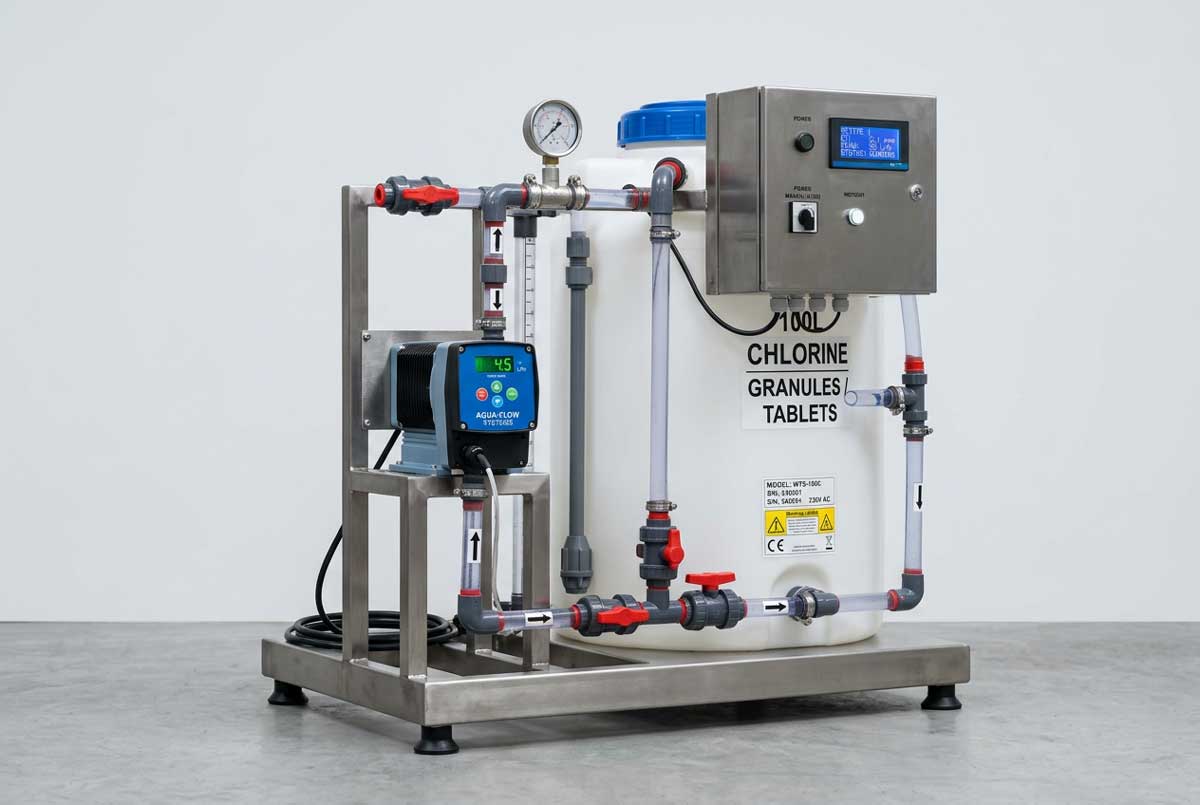
A chlorination package is a ready-made, engineered assembly for preparing, storing, and dosing a chlorine solution into water or effluent. This package usually includes a polyethylene tank, a dosing pump, a mixer, an electrical panel, a chassis, piping equipment, valves, and control equipment.
The main goal of chlorination is disinfecting water or effluent and reducing the amount of pathogenic microorganisms before discharge, storage, or reuse.
Chlorination can be done using various substances; but in many projects, chlorine-based solutions such as sodium hypochlorite are options worth considering due to the ease of transport, storage, and dosing.
The choice of the type of disinfectant, the dosing amount, the contact time, and the installation location of the package must be determined based on the specifications of the water or effluent and the project requirements.
How Does the Chlorine Dosing Package Work?
The operation of the chlorination package is based on preparing a chlorine solution and dosing it precisely into the pipeline, the contact tank, or the transfer route of the water and effluent.
The process usually includes the following stages:
- Storing the chlorine solution in the polyethylene tank
- Mixing and homogenizing the solution if needed
- Suction of the solution by the dosing pump
- Adjusting the dosing rate based on the project’s needs
- Dosing the chlorine solution into the water or effluent line
- Providing sufficient contact time for disinfection to occur
- Controlling the residual chlorine, if needed
- Discharging, storing, or using the water and effluent in accordance with the project standard
The dosing pump can be controlled manually, semi-automatically, or fully automatically. In sensitive projects, the dosing control can be based on the flow rate, residual chlorine measurement, or a command from the central control system.
The Role of Chlorination in Water and Wastewater Treatment
Chlorination is usually used at the end of the treatment process or at specific points on the water and effluent transfer line. This process is not a substitute for physical, chemical, or biological treatment; rather, it is used as a disinfection or microbial-control stage.
In a wastewater treatment system, the chlorination package can be installed after the following units:
- Activated sludge wastewater treatment package
- EAAS wastewater treatment package
- SBR wastewater treatment package
- MBBR wastewater treatment package
- IFAS wastewater treatment package
- MBR wastewater treatment package
- Sand filter and carbon filter
- Supplementary treatment units
- Treated effluent storage tank
In such conditions, disinfection can help reduce the microbial load of the effluent and prepare it for discharge or reuse, if it complies with the required standard.
Main Components of the Chlorination Package
The chlorination package is designed according to the capacity, the type of chemical, the installation conditions, and the required level of automation. The main components of this system can include the following:
Polyethylene Tank
The polyethylene tank is used to store the chlorine solution or other disinfectants. The tank must be chosen from a suitable material that is resistant to chemicals.
Important features of the chlorination tank:
- Suitable resistance to corrosion
- Resistance to chemicals
- The ability to be installed in industrial environments
- The ability to be chosen in various capacities
- The possibility of using a single-layer, double-layer, or triple-layer tank suited to the project
- The possibility of installing a level sensor and alarm equipment
Dosing Pump
The dosing pump is the most important piece of equipment in the chlorination package for the precise, adjustable dosing of the chlorine solution.
The functions of the dosing pump include the following:
- Suction of the solution from the tank
- Dosing the disinfectant into the pipeline or tank
- Adjusting the dosing amount
- Controlling the flow rate of the chemical
- The possibility of connecting to the automation system
- The possibility of manual or automatic adjustment suited to the water or effluent flow rate
In various projects, depending on the type of chemical, the line pressure, the required flow rate, and the operating conditions, diaphragm, solenoid, or suitable industrial dosing pumps can be used.
Tank Mixer
In some applications, a mixer is used to homogenize the chlorine solution or prepare the solution in the tank.
The mixer of the chlorination package can include the following:
- Electric motor
- Corrosion-resistant shaft
- Chemically resistant impeller
- A holding and mounting system on the tank
The choice of mixer must be made based on the type of disinfectant, the tank volume, the solution concentration, and the operating conditions.
Chlorination Package Chassis
All the main equipment of the package, including the tank, pump, electrical panel, mixer, and piping, can be mounted on a metal chassis or a suitable structure.
A suitable chassis provides the following advantages:
- Easier transport of the equipment
- Greater order in the layout of the package
- Reduced installation time at the project site
- Better access for servicing and maintenance
- The possibility of building the package as an integrated, prefabricated unit
Electrical Panel and Control System
The electrical panel is responsible for controlling the operation of equipment such as the dosing pump, the mixer, the level sensors, and the alarm system.
Depending on the project’s needs, the electrical panel can be designed as follows:
- Manual control
- Semi-automatic control
- Fully automatic control
- Control based on the flow rate
- Control based on time
- Control based on residual chlorine
- The ability to connect to a PLC or central monitoring system
- Equipped with a low-solution alarm for the tank
- Equipped with protection for the pump and electrical equipment
Piping and Dosing Equipment
The dosing section of the package can include the following equipment:
- Chemically resistant pipe and fittings
- Check valve (non-return valve)
- Dosing valve
- Dosing injector
- Relief valve
- Drain valve
- Suction filter
- Chemically resistant suction hose or pipe
- Flow meter or flow-control equipment if needed
The choice of pipe and fitting material must be consistent with the type of disinfectant and the line-pressure conditions.
Types of Chlorination Packages
Chlorination packages can be categorized based on the type of disinfectant, the tank capacity, the control method, and the project application.
Manual Chlorination Package
In the manual model, the dosing amount of the disinfectant is adjusted by the operator. This model can be suitable for smaller projects or applications with constant conditions.
Semi-Automatic Chlorination Package
In this model, part of the operation of the pump and mixer is controlled automatically; but the main settings or the dosing amount may be done by the operator.
Automatic Chlorination Package
In the automatic model, the dosing pump can be coordinated with the water flow rate, the timing, the tank level, or residual chlorine measurement.
This model is more suitable for projects that need more precise control, reduced human error, and performance logging.
Sodium Hypochlorite Dosing Package
This model can be used for dosing a sodium hypochlorite solution in the disinfection of water, wastewater, and effluent. The choice of concentration, dosing amount, and related equipment must be made based on the project conditions.
Chlorination Package for Wastewater and Effluent
This model is usually installed after the biological or supplementary treatment units, and its goal is to reduce the microbial contamination of the effluent before discharge or reuse.
Drinking Water Chlorination Package
In drinking water projects, the chlorination design must be done with greater care; because the dosing amount, the contact time, the residual chlorine, and the water quality must be consistent with the relevant criteria and standards.
Applications of the Chlorination Package
The chlorination package can be used in various water and wastewater projects, including:
- Disinfecting drinking water
- Disinfecting treated effluent
- Urban and rural water treatment plants
- Domestic wastewater treatment packages
- Industrial wastewater treatment
- Water storage tanks
- Water and effluent recycling systems
- Swimming pools and aquatic complexes
- Food industries
- Livestock farms and poultry farms
- Greenhouses and agricultural units
- RO systems and industrial water treatment
- Civil construction and workshop projects
- Buildings, hotels, and accommodation complexes
- Hospitals and medical centers, after reviewing the project conditions
Advantages of the Polyethylene Chlorination Package
The polyethylene chlorination package can have the following advantages in suitable projects:
- Suitable resistance to corrosion
- The ability to be designed and built in various capacities
- Quick installation capability
- The possibility of executing the package as an integrated unit
- The ability to adjust the dosing amount
- The possibility of manual, semi-automatic, or automatic control
- Suitable for water, effluent, and wastewater
- The possibility of installing a level sensor and a low-solution alarm
- The possibility of connecting to a central control system
- Relatively simple repair and maintenance
- The ability to use various dosing pumps
- The possibility of customizing the equipment based on the project conditions
Important Points in Designing a Chlorination Package
Designing a chlorination package should not be done based on the tank volume alone. To choose the correct equipment and dosing amount, various factors must be reviewed:
- The water or effluent flow rate
- The quality of the inlet water or effluent
- The amount of microbial contamination
- The type of disinfectant
- The concentration of the chlorine-based substance
- The dosing point
- The required contact time
- The required residual chlorine
- The fluid temperature
- The pH
- The presence of organic matter, ammonia, or chlorine-consuming compounds
- The dosing-line pressure
- The type of use of the output water or effluent
- The need for manual or automatic control
- The space available for installing the equipment
In sensitive projects, determining the exact dosing amount must be done based on testing, the water or effluent quality, the operating requirements, and the relevant standards.
What Is Residual Chlorine and Why Is It Important?
After chlorine is dosed, part of it reacts with the organic matter, microorganisms, and compounds present in the water or effluent. The amount of chlorine that remains in the water after these reactions is called residual chlorine.
Controlling residual chlorine is very important; because:
- Too little of it may reduce the effectiveness of disinfection.
- Too much of it can be undesirable for some applications.
- Its suitable amount depends on the type of water, the type of use, the contact time, and the project criteria.
- In automatic projects, a residual chlorine analyzer can be used to control the dosing pump.
What Is Chlorine Contact Time?
Contact time is the duration for which the chlorine solution, after being dosed, has the opportunity to remain in contact with the water or effluent so that the disinfection process can take place.
For this reason, in many projects a chlorine contact tank or a piping route with a suitable retention time is provided after the dosing point.
Without sufficient contact time, even if the disinfectant is dosed, the expected result in terms of reducing microbial contamination may not be achieved.
The Difference Between the Chlorination Package and a UV System
Chlorination and UV are both used for disinfection, but their operation is different.
In the chlorination system, the disinfectant is dosed into the water or effluent and, if adjusted correctly, can create a residual effect in the transfer route.
In the UV system, disinfection is done with ultraviolet radiation, and no chemical is added to the water. But UV usually has no residual effect in the route, and the quality of the inlet water, especially the clarity and the amount of suspended solids, has a great effect on its efficiency.
The choice between chlorination and UV must be made based on the type of project, the water or effluent quality, the output requirements, the available space, the operating cost, and the need for residual chlorine.
The Difference Between the Chlorination Package and Ozonation
Ozonation is also one of the disinfection methods, but it needs equipment such as an ozone generator, a dosing system, and special safety equipment.
The chlorination package is usually simpler in terms of structure, equipment, and operation, and is more widely used in many water and wastewater projects.
However, the choice of disinfection method must be made based on the real conditions of the project and the required output quality.
Safety Points for the Chlorination Package
Chlorine-based substances can be corrosive and irritating. For this reason, the design, installation, and operation of the chlorination package must be done while observing safety principles.
The most important safety points are:
- Installing the package in a location with suitable ventilation
- Using personal protective equipment during servicing and charging the substances
- Preventing contact of chlorine-based substances with acids or incompatible materials
- Using a tank and piping resistant to chemicals
- Providing a leak-collection tray or containment basin in projects that require it
- Installing a level sensor to prevent the pump from running dry
- Using a check valve and safety equipment on the dosing line
- Installing warning labels and an operating manual
- Periodic servicing of the dosing pump, mixer, and dosing equipment
- Training the operator before operating the package
Chlorination Package for Treated Effluent
In many wastewater treatment packages, chlorination is used as the final disinfection stage.
After leaving the biological units such as activated sludge, EAAS, SBR, MBBR, IFAS, or MBR, the effluent can enter the chlorine contact tank.
Choosing a chlorination package for treated effluent must be done based on the following:
- The output effluent flow rate
- The amount of remaining suspended solids
- The microbial quality of the effluent
- The type of final use of the effluent
- The available contact time
- The required amount of residual chlorine
- The need to remove or control residual chlorine before discharge, if the project requires it
- The discharge or reuse standard
What Factors Does the Price of the Chlorination Package Depend On?
The price of the chlorination package depends on the technical specifications and the equipment required for the project.
The most important factors affecting the price are:
- The capacity of the polyethylene tank
- The type and concentration of the disinfectant
- The type of dosing pump
- The required dosing flow rate and pressure
- The need for a mixer
- The material of the mixer shaft and impeller
- The type of electrical panel
- The level of automation
- The need for a PLC
- The need for a level sensor
- The need for a residual chlorine sensor
- The type of chassis
- The material of the piping and valves
- The presence of a chlorine contact tank
- The transport, installation, and commissioning conditions
- The need for safety and leak-control equipment
For an exact price quote, the fluid flow rate, the type of water or effluent, the disinfectant, the line-pressure conditions, the required dosing amount, and the project’s level of automation must be specified.
Design and Construction of the Chlorination Package by Poly Payesh
Poly Payesh designs and builds the chlorination package to suit the real conditions of the project.
In the technical review stage, the following are evaluated:
- The type of use of the water or effluent
- The flow rate
- The fluid quality
- The disinfection goal
- The dosing point
- The type of disinfectant
- The required tank capacity
- The dosing pump flow rate and pressure
- The available contact time
- The need for residual chlorine control
- The level of automation
- The installation space
- The need for safety equipment
- The operation and maintenance conditions
The goal is to design a system that is consistent with the project’s needs in terms of dosing precision, safety, maintenance, and operating cost.
To receive specialized consultation, a technical review of your project, and a price quote for the polyethylene chlorination package, get in touch with the experts at Poly Payesh.
Frequently Asked Questions About the Chlorination Package
What is a chlorination package?
A chlorination package is a ready-made system for storing, preparing, and dosing a chlorine solution in a controlled way into water, effluent, or wastewater for the purpose of disinfection.
What equipment does a chlorination package have?
This package usually includes a polyethylene tank, a dosing pump, a mixer if needed, an electrical panel, a chassis, piping, valves, dosing equipment, and control sensors.
Is the chlorination package suitable for wastewater?
Yes. The chlorination package can be used after the wastewater treatment stages to disinfect the treated effluent.
What is the function of the dosing pump?
The dosing pump draws the chlorine solution from the tank at an adjustable flow rate and pressure and doses it into the water or effluent line.
Is the chlorine dosing amount the same for all projects?
No. The dosing amount depends on the flow rate, the type of water or effluent, the pH, the temperature, the amount of organic matter, the contact time, and the required output quality.
What is residual chlorine?
Residual chlorine is the amount of chlorine that remains after reacting with the substances present in the water or effluent. Controlling it is important to ensure the effectiveness of disinfection and to prevent over-dosing.
Can the chlorination package be automatic?
Yes. The chlorination package can be designed as manual, semi-automatic, or fully automatic, and in the automatic models, dosing is controlled based on time, flow rate, or residual chlorine measurement.
Is the chlorination package a substitute for wastewater treatment?
No. Chlorination is a disinfection stage and is not a substitute for the main physical, chemical, or biological treatment processes.
What information is needed to request a price for the chlorination package?
The water or effluent flow rate, the type of fluid, the type of disinfectant, the line pressure, the dosing point, the level of automation, the tank capacity, and the disinfection goal are important pieces of information for design and pricing.