

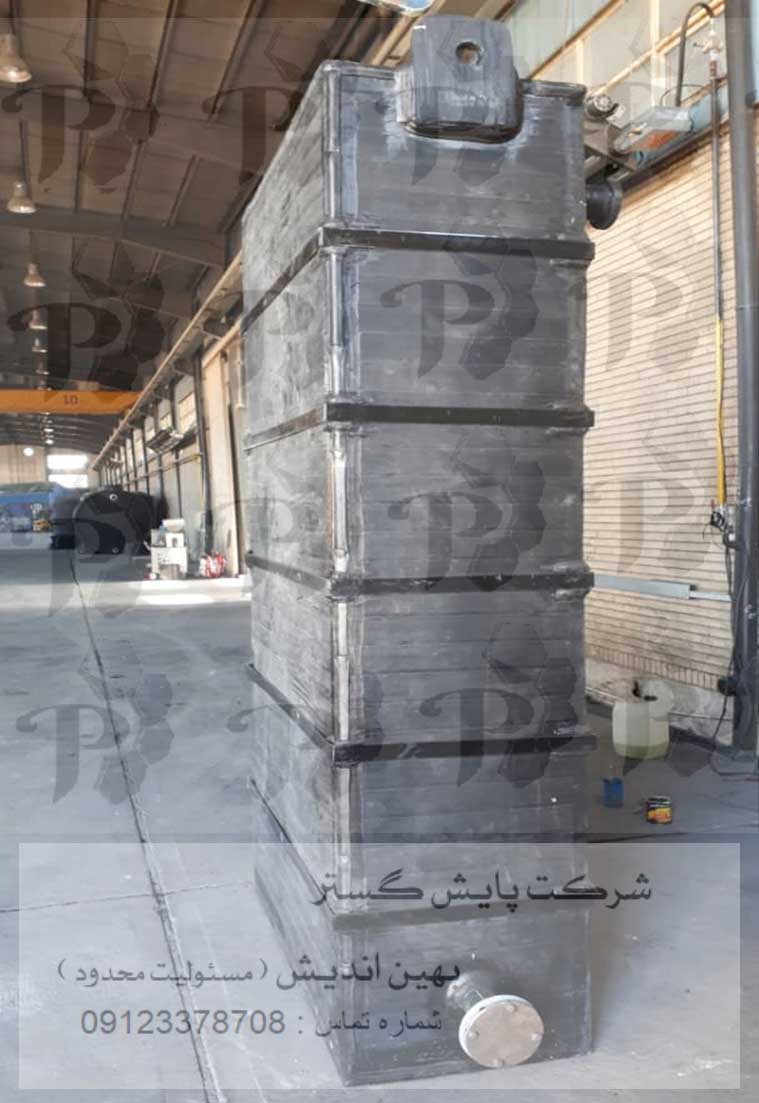
The cubic (or rectangular-cuboid) polyethylene tank is a storage tank with a four-sided design, engineered for maximum use of the available space in indoor environments, mechanical rooms, utility rooms, spaces alongside walls, and locations with dimensional limitations.
Unlike cylindrical tanks with their round form, the cubic tank can better cover the space of corners and walls. This feature makes it a practical option in projects where the orderly arrangement of equipment and optimal use of the indoor space are important.
Poly Payesh designs the cubic polyethylene tank based on the dimensions of the installation location, the required volume, the type of fluid, the internal pressure, the inlet and outlet route, the operating conditions, and the project’s architectural limitations.
What Is a Cubic Polyethylene Tank?
A cubic polyethylene tank is a tank with a square or rectangular form, used for storing water, industrial fluids, process water, liquid raw materials, and some chemicals compatible with polyethylene.
In this type of tank, the indoor space of the environment is used better, because the body has flat, angular surfaces and can be installed close to a wall, inside a utility room, a mechanical room, or between equipment.
However, compared to the cylindrical form, the cubic form requires more attention to the design of the walls, corners, and reinforcements, and to controlling the deformation caused by fluid pressure.
What Spaces Is the Cubic Tank Suitable For?
- Mechanical rooms
- Utility rooms
- Building basements
- Indoor spaces of factories
- Manufacturing units
- Workshops
- Food and pharmaceutical industries, with observance of the relevant requirements
- Laboratories and technical spaces
- Buildings and towers
- Projects with length or width limitations
- Spaces alongside walls
- Projects that need several tanks arranged side by side
Advantages of the Cubic Polyethylene Tank
- Better use of the available space
- Suitable for corners and alongside walls
- Suitable for indoor environments
- The ability to be designed with custom dimensions
- The ability to arrange several tanks side by side
- Suitable resistance to corrosion
- No rusting
- Suitable for storing water and compatible fluids
- The ability to connect to a pump, filter, and process equipment
- Suitable access to fittings and hatches
- Relatively simple maintenance and servicing
- Suitable for special architectural and utility projects
An Important Point in Designing the Cubic Tank
In cylindrical tanks, the fluid pressure is distributed more uniformly over the curved wall. But in a cubic tank, the flat walls and corners can be subjected to more stress.
For this reason, the design of the cubic tank must pay special attention to the following:
- Suitable wall thickness
- The design of horizontal and vertical reinforcements
- Controlling the deformation of the body panels
- Reinforcing the corners
- The design of the tank bottom
- The type of foundation or underlying surface
- The fluid height
- The type of stored material
- The internal pressure
- The frequency of filling and emptying
- The type of connection for the nozzles and piping
The cubic tank should not be chosen merely because of its better use of space; it must also be structurally consistent with the volume and application of the project.
Main Components of the Cubic Polyethylene Tank
Body and Walls
The walls of the cubic tank must be designed to suit the fluid height, the volume, the type of material, and the internal pressure. In many designs, reinforcements are used to control the deformation of the wall.
Corners and Joints
The corners are among the sensitive parts of the cubic tank. The correct design and execution of these areas is very important for reducing stress concentration.
Tank Bottom
The bottom must sit on a completely level, durable, and uniform surface. Any unevenness or point support can cause undesirable stress to be transferred to the body.
Inlet and Outlet
The inlet, outlet, bottom drain, overflow, and process lines must be designed based on the tank’s application.
Inspection Manhole
The manhole is used for inspection, cleaning, servicing, and access to the internal space of the tank.
Vent
If needed, a vent is provided to balance the pressure during the filling and emptying of the tank.
Level Control Equipment
The cubic tank can be equipped with a float, a level sensor, a volume indicator, an overflow alarm system, and pump control.
Applications of the Cubic Polyethylene Tank
- Storing water in mechanical rooms
- Building water storage tank
- Firefighting water tank in indoor spaces
- Process water tank in factories
- Liquid raw-material tank
- Tank for compatible chemical solutions
- Storage tank in water and wastewater treatment lines
- Greenhouse or agricultural water storage tank in covered spaces
- Tank needed by food and pharmaceutical industries, appropriate to the project requirements
- Storage tank in workshops and confined spaces
The Difference Between the Cubic Tank and the Cylindrical Tank
The cubic tank is more suitable for the optimal use of confined space; however, in terms of structural stresses, it requires more precise design in the walls and corners.
The cylindrical tank usually has a more uniform stress distribution and is the more common option for open spaces or storing larger volumes.
In summary:
- Cubic tank: suitable for indoor space, alongside walls, mechanical rooms, and compact arrangement
- Vertical cylindrical tank: suitable for storing large volumes in a smaller footprint
- Horizontal tank: suitable for height limitations or longitudinal space
- Buried tank: suitable for projects that need the ground surface to be free
Installation Points for the Cubic Polyethylene Tank
- Installation on a completely level, uniform surface
- Preventing point support beneath the tank bottom
- Maintaining suitable distance from the wall for servicing and inspection
- Controlling the piping load and preventing the transfer of weight to the nozzles
- Using flexible fittings if needed
- Providing an overflow and discharge route
- Checking the condition of the manhole and safe access
- Suitable ventilation design in enclosed environments
- Reviewing the type of flooring and its resistance to the weight of the full tank
- Reviewing the type of fluid before choosing the materials and fittings
Capacity of the Cubic Polyethylene Tank
The capacity of the cubic tank is determined based on the following:
- The dimensions of the available space
- The required storage volume
- The permissible height
- The type of fluid
- The internal pressure
- The application of the building or factory
- The number of tanks needed
- The possibility of parallel arrangement
- The inlet and outlet route
- The need for future expansion
- Operating and access limitations
In many projects, using several smaller cubic tanks side by side can create more flexibility than a single large tank; however, this decision must be made with attention to the installation space, cost, piping, and operating method.
Price of the Cubic Polyethylene Tank
The price of the cubic tank depends on the following factors:
- The capacity and dimensions
- The tank height
- The type of fluid
- The thickness and structure of the body
- The need for reinforcements
- The number of nozzles
- The type of manhole
- The need for a vent and overflow
- The level control equipment
- The conditions of the installation location
- The need for custom manufacturing
- The type of fittings and piping
- The number of tanks needed in the project
To receive consultation, a review of the installation-location dimensions, and a price quote for the cubic polyethylene tank, get in touch with the experts at Poly Payesh.
Frequently Asked Questions About the Cubic Polyethylene Tank
What spaces is the cubic polyethylene tank suitable for?
For mechanical rooms, utility rooms, basements, indoor industrial environments, confined spaces, and locations where maximum use of space is important.
Is the cubic tank suitable for drinking water?
If sanitary-grade materials are used, along with a suitable design and observance of the project’s regulations, it can be considered.
What is the difference between the cubic tank and the vertical tank?
The cubic tank fills the indoor space better and is more suitable for installation alongside a wall. The vertical cylindrical tank is usually used for storing a large volume with a smaller footprint.
Is the cubic tank suitable for chemicals?
It can be used for materials compatible with polyethylene, but the type of material, the concentration, the temperature, and the operating conditions must be reviewed before the design.