

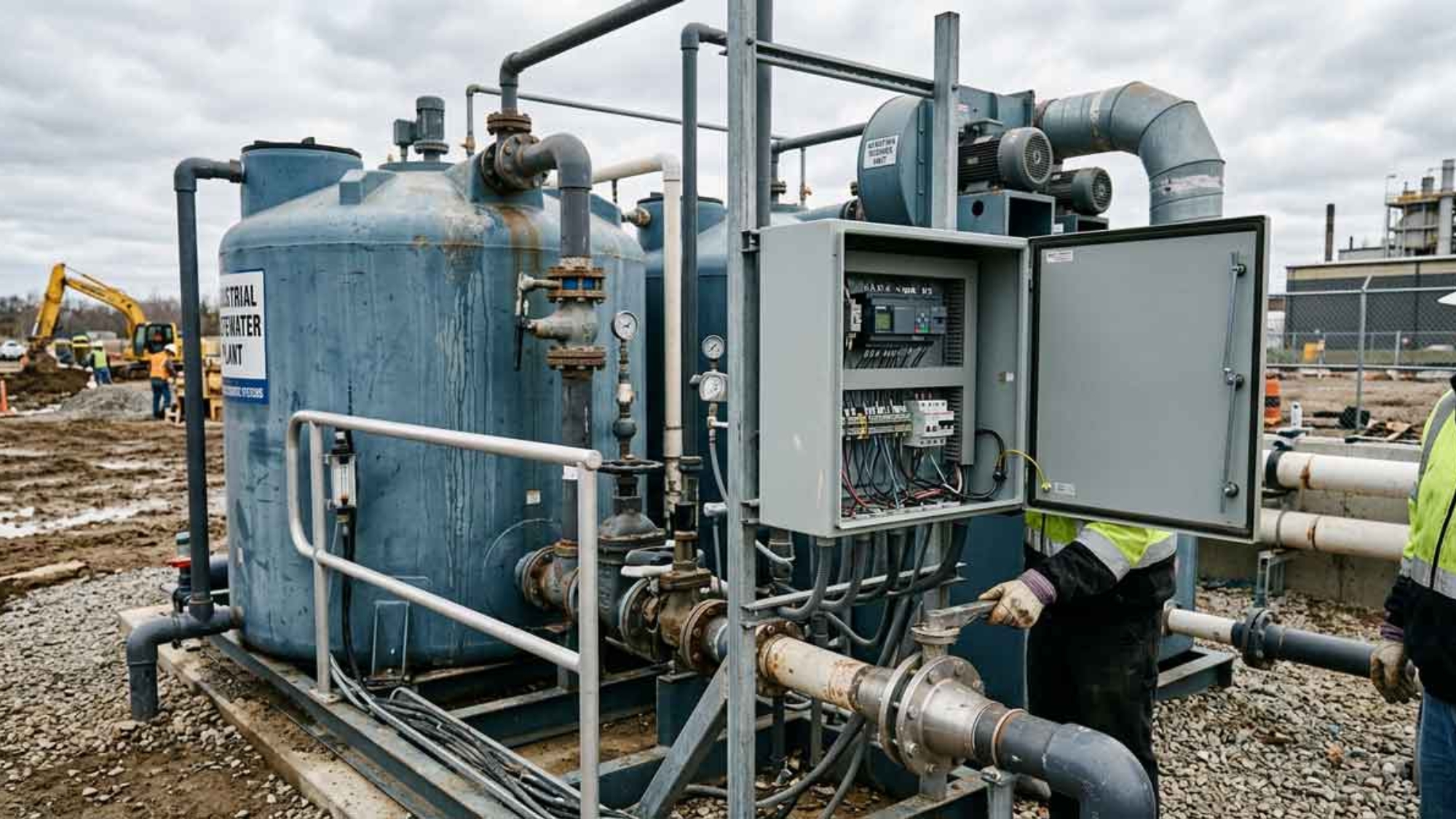
One of the most important questions in designing and selecting a domestic wastewater treatment package is the comparison between the SBR system and the Extended Aeration system. Both systems work on the basis of the activated sludge process and aerobic biological treatment, but they differ significantly in how they operate, their process structure, control equipment, operation, effluent quality, installation cost, and conditions of use. Today, both technologies are used in polyethylene, metal, and fiberglass wastewater treatment packages, but the correct choice between them must be based on the real conditions of the project.
What Is the Extended Aeration System?
The Extended Aeration system is one of the most common methods of domestic wastewater treatment and has been used for years in building, villa, and industrial projects. This system is essentially a more stable, developed version of the activated sludge process, in which the aeration time is increased so that the process becomes more stable, sludge production is reduced, and operation is simpler. In this system, wastewater enters the aeration tank continuously, where the blower generates air, the diffuser transfers oxygen into the wastewater, and aerobic bacteria decompose the organic matter; the wastewater then enters the sedimentation tank so that the activated sludge is separated from the effluent, and part of this sludge is returned to the aeration tank.
What Is the SBR System?
SBR stands for Sequencing Batch Reactor and also works on the basis of activated sludge, but its main difference lies in the type of treatment process; in this system, all treatment stages take place in a single tank on a timed basis. This system usually operates in several defined cycles: in the Fill phase, wastewater enters the tank; in the React (aeration) phase, the blower and diffuser are activated and the biological process is carried out; in the Settle phase, aeration is stopped and the sludge settles; in the Decant phase, the clarified effluent is discharged from the tank; and finally, part of the excess sludge is also removed from the system.
Technical and Operational Comparison of SBR and Extended Aeration
The table below shows the most important differences between these two systems across key aspects.
| Comparison Criterion | Extended Aeration | SBR |
|---|---|---|
| Mode of operation | Continuous, with constant wastewater inflow and outflow | Intermittent, cyclical, and timed |
| Number of tanks | Several separate tanks (aeration, sedimentation, sludge) | Most stages in a single tank |
| System control | Simpler, easier operation | Dependent on a PLC, sensors, and precise timing |
| Effluent quality | Suitable for normal standards | Usually higher quality, suitable for strict standards |
| Operational stability | High stability against flow and pollution-load fluctuations | More sensitive to PLC or sensor faults |
| Cost | Simpler and more economical to design and maintain | Higher cost due to automation and PLC |
| Space required | Requires more tanks and larger space | More compact, less space |
The Importance of the PLC in the SBR System
In an SBR wastewater treatment package, the PLC is considered the most important control part of the system and is responsible for controlling the aeration time, settling time, blower operation, pump operation, effluent discharge, and overall cycle management. In many professional systems, European and German industrial PLCs are used to increase operational accuracy and system stability, because the quality of the PLC has a direct impact on the final efficiency of the SBR system.
Which System Is Better for a Villa?
In many villa projects, the Extended Aeration system is very popular because of its high stability and simpler operation, and it is more resistant to flow fluctuations, changes in pollution load, and operator errors. However, in projects where limited space, high effluent quality, and precise automation matter, the SBR system is the more suitable choice.
Polyethylene SBR and Extended Aeration Wastewater Treatment Packages
Today, both systems are also produced as polyethylene wastewater treatment packages and benefit from the advantages of this material, including corrosion resistance, complete water-tightness, suitability for burial, lighter weight, and fast installation. Both technologies can be installed either buried or above-ground; with above-ground models, note that the wastewater must either enter the system by gravity or be conveyed to the package by a pumping station.
Conclusion
The SBR system and the Extended Aeration system are both among the most important technologies for domestic wastewater treatment, operating on the basis of activated sludge and the aerobic process. Extended aeration—thanks to its high stability, simple operation, and greater resistance to fluctuations—is one of the most common options for villa and building projects, whereas the SBR system, using a control PLC, timed cycles, and precise automation, provides higher quality in controlling the treatment process and is a very suitable option for projects with space constraints and strict effluent standards. The final choice should always be made based on the technical conditions, the real budget, and the specific needs of each project—not on a one-size-fits-all template.