

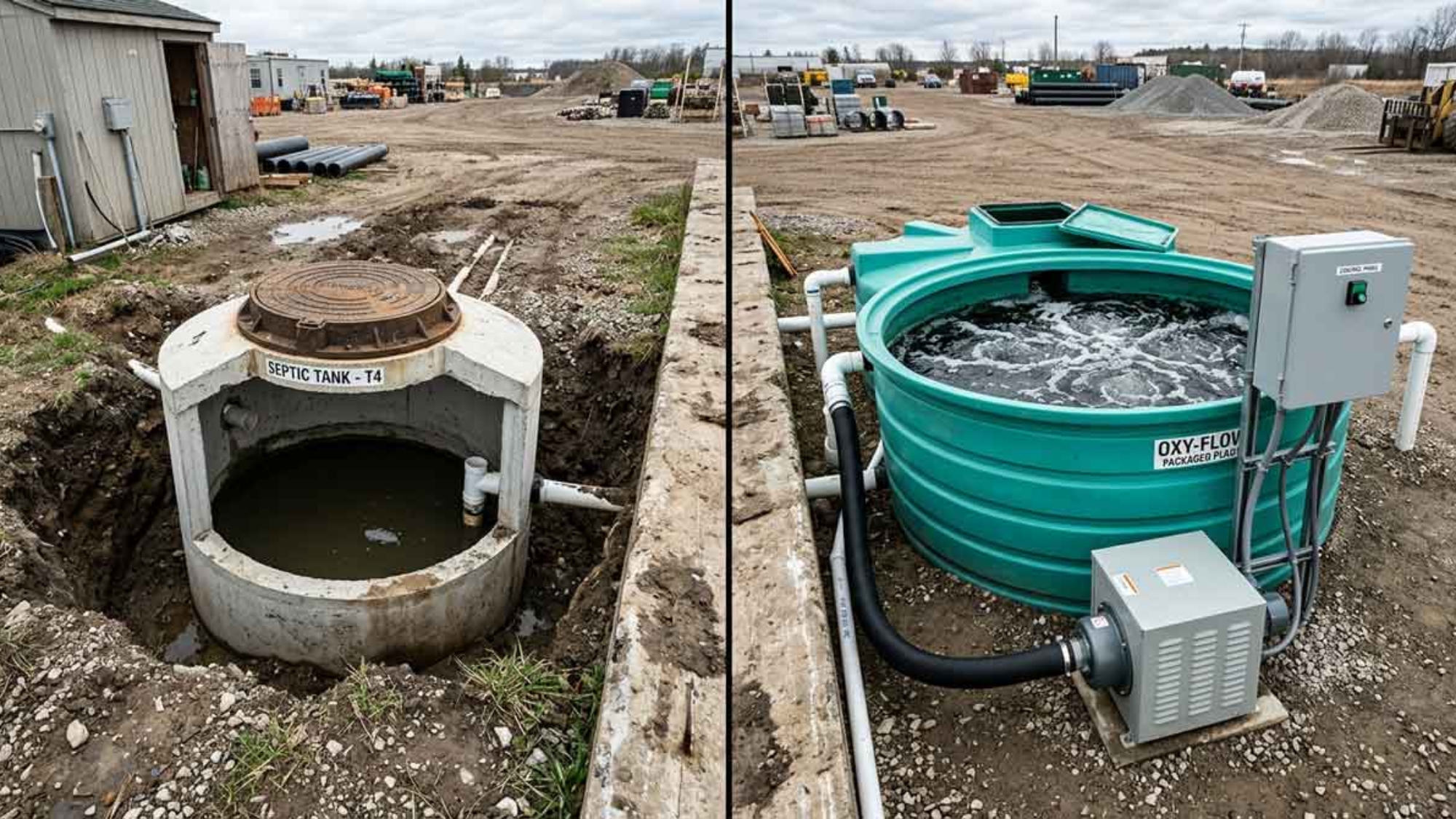
One of the common questions in building, villa, and industrial projects is whether to install a septic tank or a wastewater treatment package to manage domestic sewage. Although both systems are used to control and reduce wastewater pollution, they differ fundamentally in how they operate, treatment efficiency, cost, power requirements, and the quality of the effluent. Choosing the wrong one can lead to problems such as unpleasant odors, soil contamination, system overflow, or extra costs, so understanding the differences precisely before deciding is essential.
What Is a Septic Tank?
A septic tank is a primary wastewater treatment system whose operation is based on physical and anaerobic biological processes. In this system, wastewater enters the tank, solids settle to the bottom, fats separate at the surface, and anaerobic bacteria break down part of the organic matter. A septic tank requires no electricity, complex mechanical equipment, or continuous monitoring, which makes its installation and maintenance costs lower. However, its treatment efficiency is limited, and the effluent usually needs further treatment such as a soakaway (absorption well).
What Is a Wastewater Treatment Package?
A wastewater treatment package is a more complex, engineered system that, in addition to the physical stages, also includes aerobic biological processes. In this system, wastewater passes through the stages of equalization, aeration, activated sludge formation, sedimentation, and disinfection. Equipment such as blowers, diffusers, and control systems make it possible to reduce the pollutants in the wastewater far more effectively and to produce higher-quality effluent that can even be reused for landscape irrigation.
Technical Comparison of Septic Tank and Wastewater Treatment Package
The table below summarizes the most important differences between the two systems.
| Feature | Septic Tank | Wastewater Treatment Package |
|---|---|---|
| Process type | Physical and anaerobic biological | Physical, aerobic biological, and disinfection |
| Treatment efficiency | Moderate and limited | Very high |
| Power requirement | Usually zero or very low | Requires blower and electrical equipment |
| Installation cost | Lower | Higher |
| Maintenance cost | Low | Relatively higher; requires periodic inspection |
| Effluent quality | Needs further treatment | Reusable, high quality |
| Space and equipment needs | Simpler | More complex; includes multiple tanks and a control section |
| Suitable for | Small and medium projects with a limited budget | Projects requiring high effluent quality |
Difference in How They Operate
The most important difference between the two systems is the type of bacteria active in the treatment process. In a septic tank, anaerobic bacteria work without oxygen and the rate of organic-matter decomposition is relatively low, whereas in a wastewater treatment package, oxygen introduced through the blower activates aerobic bacteria that significantly increase the speed and quality of organic-matter decomposition. This is the difference that keeps the effluent from a wastewater treatment package at much lower BOD and COD levels.
Which System Is More Suitable?
Choosing between a septic tank and a wastewater treatment package depends on factors such as the number of users, the project budget, the required effluent quality, and access to electricity. If the project has budget constraints and does not need very high effluent quality, a septic tank is the more economical and simpler option. But for projects with stricter environmental standards or where effluent reuse is intended, a wastewater treatment package is the more suitable choice.
Conclusion
Both septic tanks and wastewater treatment packages are designed to manage domestic sewage, but they differ fundamentally in process complexity, efficiency, cost, and effluent quality. A septic tank is suitable for simple, low-cost projects, while a wastewater treatment package is the more engineered, professional option for projects that require higher effluent quality.