

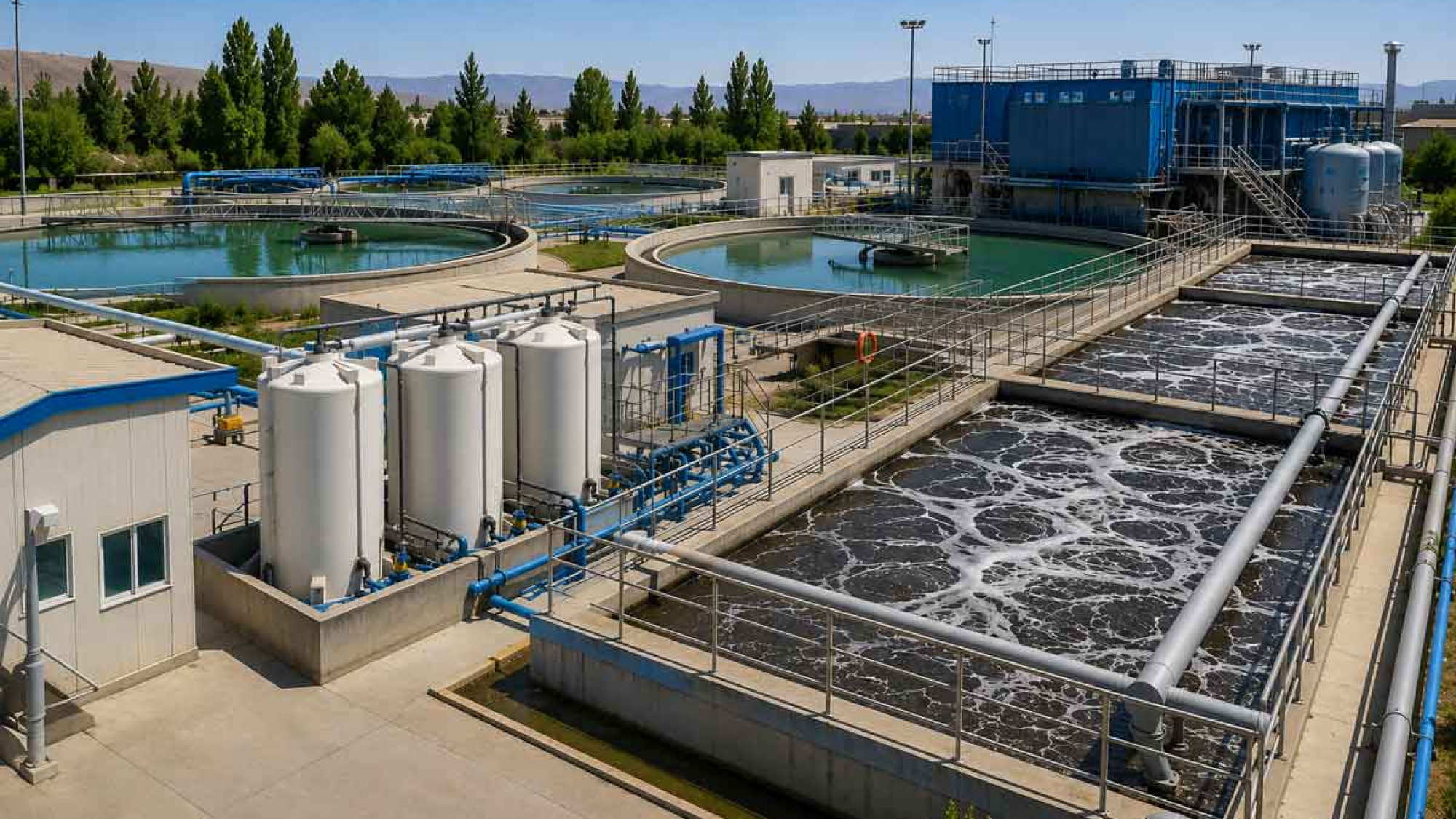
A wastewater treatment system is a set of equipment, tanks, processes, and engineering technologies designed and implemented to remove pollutants, organic matter, suspended solids, fats, microorganisms, and contaminants present in wastewater. The main goal of this process is to convert raw, polluted wastewater into an effluent that can be discharged with minimal harm to the environment or, in some cases, reused for purposes such as irrigation. Today, with the expansion of construction, increasing water consumption, the development of villas and residential complexes, and the scarcity of water resources, the use of domestic wastewater treatment systems has become one of the most important needs of building and civil projects.
What Is Domestic Wastewater?
Domestic wastewater, or sanitary wastewater, is the effluent produced by everyday human activities and usually includes wastewater from toilets, bathrooms, kitchens, laundry, washbasins, and other household uses. This wastewater contains organic matter, fats and oils, detergents, suspended solids, and a variety of bacteria and microorganisms, and if discharged directly without treatment, it can cause contamination of soil, groundwater, and the environment.
Why Is Wastewater Treatment Important?
In the past, in many projects, wastewater was discharged directly into a soakaway (absorption well), but today, for environmental and health reasons, this method alone is not sufficient. Proper wastewater treatment prevents contamination of the environment and groundwater, reduces the pollution load, extends the life of the soakaway, reduces unpleasant odors, meets environmental requirements, and even makes it possible to reuse the effluent for irrigation. For this reason, the use of septic tanks and wastewater treatment packages in many projects has shifted from an optional choice to a technical and legal necessity.
How Does a Wastewater Treatment System Work?
The wastewater treatment process usually consists of several continuous stages, each of which removes part of the wastewater’s pollution and ultimately produces effluent of acceptable quality.
Primary Treatment
At this stage, heavy solids and suspended particles are separated from the wastewater; this process usually takes place in a septic tank, sedimentation tank, or grease trap, where solid particles settle, fats collect at the surface, and a significant part of the initial pollution load is reduced.
Biological Treatment
The most important part of a wastewater treatment system is the biological process, in which bacteria and microorganisms decompose the organic matter present in the wastewater. This process can be carried out aerobically—that is, with the presence of oxygen and aeration, as in methods such as extended aeration, EASS, SBR, and MBBR—or anaerobically, without the presence of oxygen, as in the process that occurs in a septic tank. The table below shows the difference between these two approaches.
| Type of Biological Process | Operating Conditions | Example Systems |
|---|---|---|
| Aerobic | With the presence of oxygen and aeration | Extended aeration, EASS, SBR, MBBR |
| Anaerobic | Without the presence of oxygen | Septic tank |
Sedimentation and Sludge Separation
After the biological process, the sludge produced is separated from the water to create clearer effluent; this stage plays an important role in the final quality of the output effluent.
Final Disinfection
In the final stage, the effluent is disinfected so that bacteria, viruses, and other pathogens are significantly reduced and the output effluent is hygienically suitable for disposal or reuse.
Types of Wastewater Treatment Systems
Today, various systems are designed for treating domestic wastewater, each with its own application and level of treatment. The septic tank is the simplest primary wastewater treatment system, performing the sedimentation and anaerobic decomposition process, and is designed in polyethylene, buried, horizontal, and vertical types. By contrast, when more complete wastewater treatment is required, a wastewater treatment package is used, which usually includes aeration, sedimentation, activated sludge, and disinfection, and produces effluent of far higher quality than a simple septic tank.
The Most Important Wastewater Treatment Technologies
In the domestic wastewater treatment industry, a few main technologies are used more than others, each with different technical characteristics. The table below introduces these technologies.
| Technology | Description |
|---|---|
| Extended Aeration | One of the most common methods, based on activated sludge and long-term aeration |
| SBR | Sequencing Batch Reactor system that performs the entire process in a single tank on a timed basis |
| EASS | An engineered, more stable version of extended aeration, common in polyethylene packages |
| MBBR | Uses floating media for bacterial growth and increased treatment efficiency |
Why Has the Polyethylene Wastewater Treatment Package Become Popular?
Today, the use of the polyethylene wastewater treatment package has become very common due to its numerous advantages, including high corrosion resistance, complete water-tightness, the ability to be installed buried or above-ground, lighter weight, fast installation, easy maintenance, and long service life. This very combination of advantages has led many projects to replace older metal and concrete systems with polyethylene systems, especially in villa projects, where the buried system is the preferred option because it does not occupy surface space, gives the environment a better appearance, and better protects the equipment.
Important Factors in Designing a Wastewater Treatment System
Designing a wastewater treatment system is not merely selecting a simple tank; rather, it depends on numerous factors such as the number of users, wastewater flow rate, wastewater type, required effluent quality, project space, burial conditions, groundwater level, traffic load, and operating conditions. Ignoring any of these parameters can reduce the system’s efficiency or even require redesign and additional costs in the future.
Conclusion
A wastewater treatment system is a set of engineering processes for removing pollutants from domestic and sanitary wastewater and plays a very important role in protecting the environment, preventing groundwater contamination, and hygienically managing wastewater. Today, the use of polyethylene septic tanks, polyethylene wastewater treatment packages, and technologies such as extended aeration, SBR, EASS, and MBBR has become one of the main solutions for domestic wastewater treatment in building, villa, and civil projects. Choosing the right system should always be based on the number of users, the wastewater flow rate, the required effluent quality, and the execution conditions of each project—not on a one-size-fits-all template.